For California State University, unifying twenty-two independent campuses that serve almost 500,000 students was never simply a technology project. It was an operating model challenge on a scale few higher-education systems have ever attempted. Every campus had its own processes, its own ERP configuration, and its own governance culture. Bringing them together required a partner who could help the system rethink how work should flow, how value should be measured, and how procurement could own and operate its platforms in a way that delivers real performance.
What began as a blueprinting engagement evolved into a multi-year collaboration that reshaped the way CSU runs procurement work. The result is a modern operating model that drives stability, speed, and measurable value across one of the most complex public university systems in the country.
The Blueprint That Anchored a Five-Year Journey
The transformation began with strategy. RiseNow partnered with CSU leaders to build a system-wide blueprint that defined the work, the outcomes, and the operating principles needed to support a shared procurement environment. It provided clarity on sequencing, integration requirements, and governance expectations so that every decision could be measured against a common vision for value.
That blueprint became the anchor for every milestone that followed.
When conditions shifted and timelines compressed, CSU returned to that document to stay aligned on what mattered most. With strategy in place, the system could move from planning to execution.
From Early Pilots to Full System Adoption
The rollout began with upstream and Marketplace capabilities, followed by the downstream procure-to-pay environment. CSU moved intentionally at first, validating integrations and onboarding two campuses at a time. As adoption increased and stability grew, CSU and RiseNow jointly made the decision to accelerate. The final fourteen campuses were brought forward together in preparation for transition into a unified environment that could be supported, governed, and improved as a single system.
This shift was not about speed for its own sake. It was about realizing the benefits of standardization and giving procurement the ability to operate in a shared model that supports consistency, visibility, and measurable outcomes.
Solving the Hardest Problem: A Fragmented Foundation
Underneath the rollout was a deeper structural challenge. CSU’s ERP landscape looked common on paper but operated like twenty-two distinct systems. Decades of customization created variations in workflow, data, and routing logic that had to be reconciled without disrupting local needs.
RiseNow helped establish a global model that delivered a single set of processes supported by local flexibility. Campuses could adjust specific functions to meet compliance or staffing realities, while the core design remained stable and sustainable across the system.
The same approach applied to supplier onboarding and data consistency. CSU uses the JAGGAER self-service supplier portal and MBU to enable suppliers to register once and then be extended to other campuses as needed, eliminating redundant registrations and streamlining access system-wide.
This balance of standardization and flexibility became one of the defining features of CSU’s operating model and a key reason adoption grew so quickly.
Results That Prove the Work Works
As adoption increased, campuses began to see the impact of a unified operating model supported by a partner focused on outcomes rather than technology.
Fiscal stability
Year-end close occurred without the disruption many expected from such a large-scale transformation, reinforcing confidence in the stability of the new operating model.
Adoption at scale
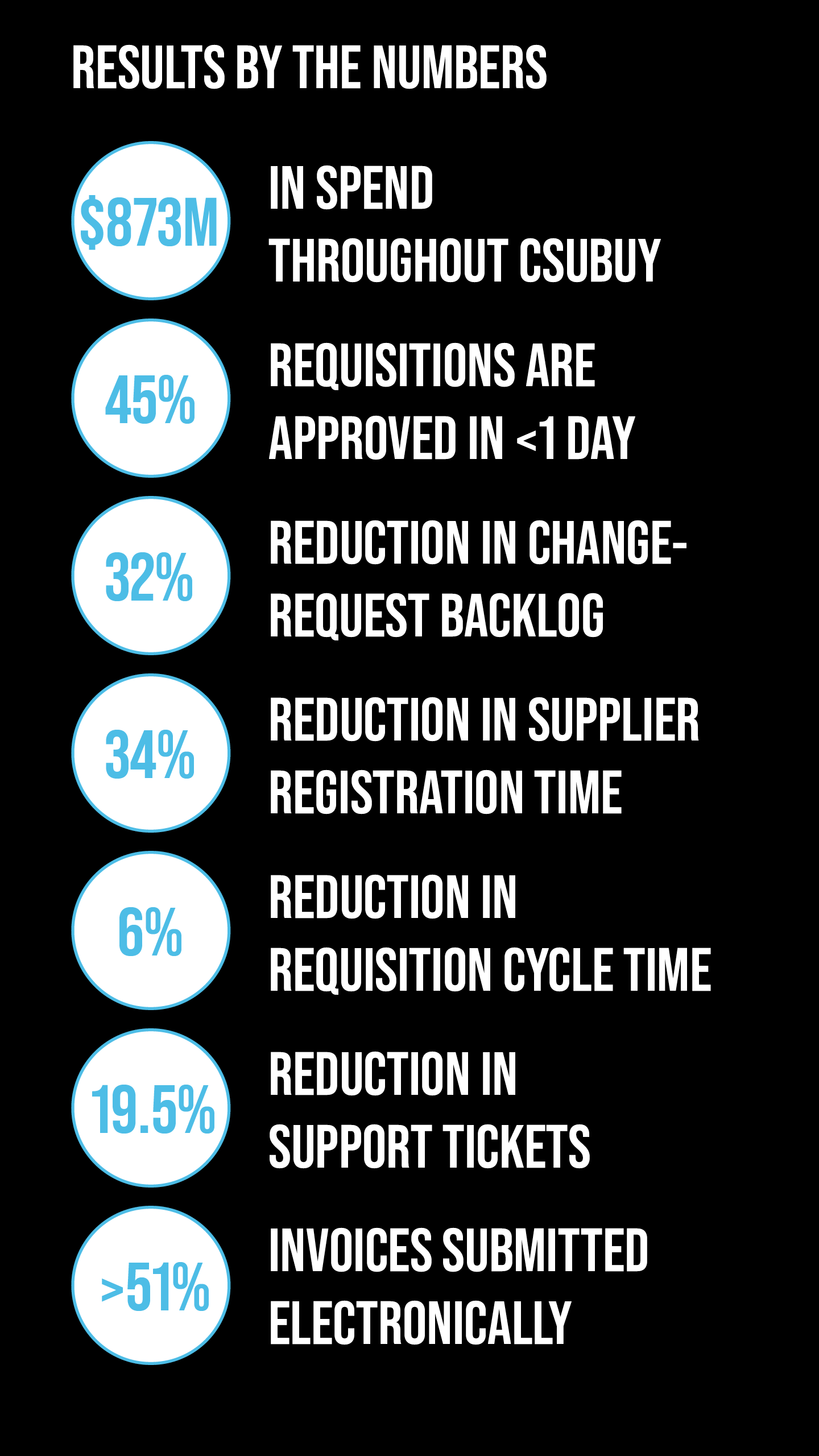
User counts and requisition volumes grew steadily across each active wave. By spring 2025, CSU recorded more than $873 million in spend through CSUBUY, with an average purchase order nearing $28,000.
Cycle time improvements
For live campuses, end-to-end cycle time from requisition through invoice is now trending under fifteen days. In fact, approximately 45 percent of completed requisitions are now reviewed and approved in less than one day.
“We’re seeing cycle time now for the campuses that are live from start to finish, from requisition through invoice, trending under fifteen days,” said David Beaver, chief procurement officer for the CSU system. “That is well below thirty days, and it allows us to start thinking about things like dynamic discounting and other ways to drive costs down because we know we have an efficient system for processing orders.”
Support performance
By mid-2025, CSU averaged 166 support tickets per week, with 82 percent resolved by RiseNow’s team. Ticket trends stabilized, and the change-request backlog dropped by thirty-two points within seven months.
Training and user experience
A structured digital enablement and training approach reduced supplier registration cycle time by 34 percent and lowered requisition cycle time by 6 percent. Support tickets declined by 19.5 percent, while training satisfaction remained consistently above 80 percent.
Compliance and control
Sensitive workflows that previously relied on manual oversight are now enforced within the system, providing consistent routing and audit-ready documentation.
Supplier performance
More than 51 percent of supplier invoices are now submitted electronically, and ACH usage continues to replace check payments as campuses transition toward fully automated disbursement.
These outcomes demonstrated that CSU’s transformation was working not because the system was deployed, but because the work inside the system was designed, governed, and supported the right way.
A Model That Continues to Create Value
The real shift began as adoption expanded. CSU expanded RiseNow’s role into a managed services model to support campuses directly and help maintain a stable, predictable operating environment.
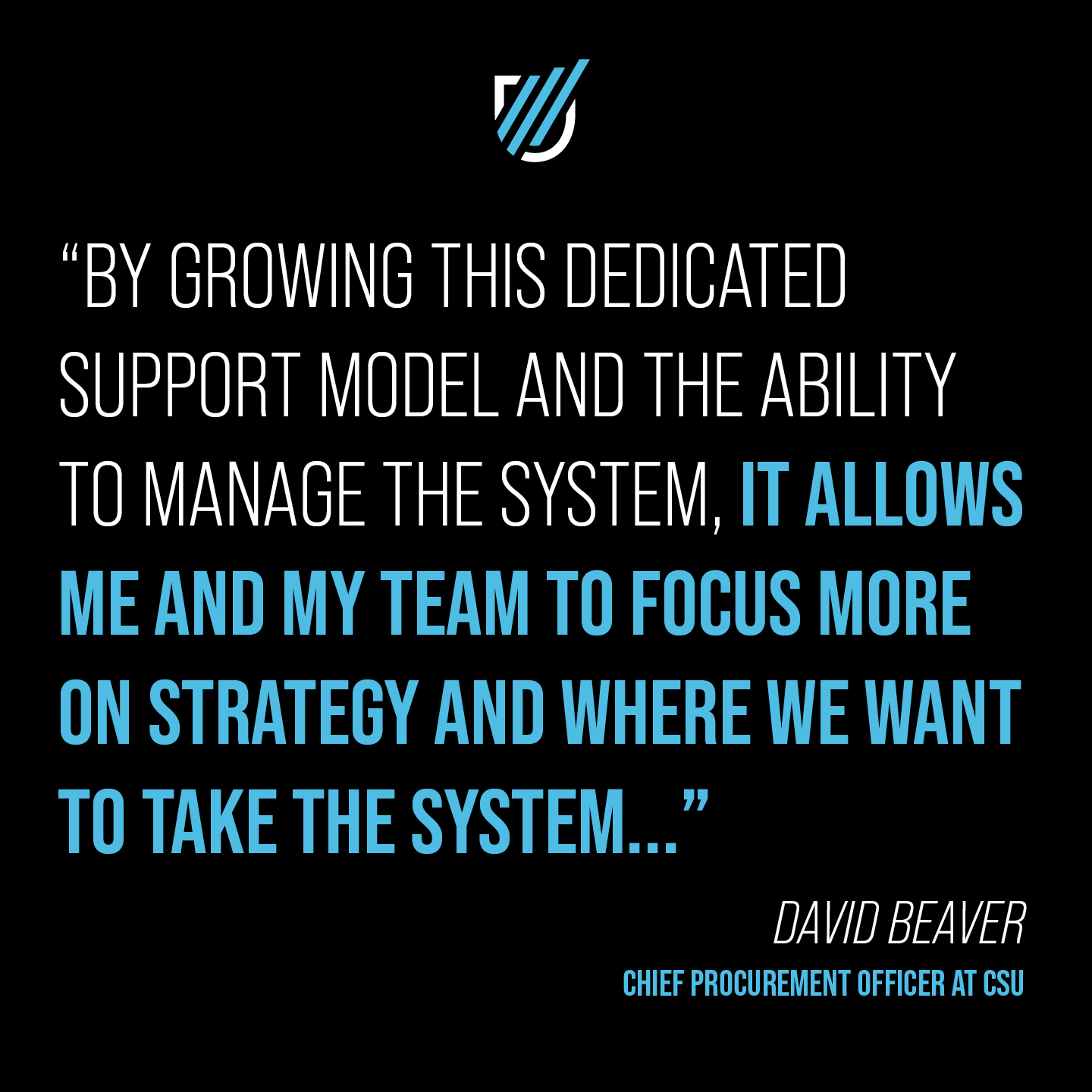
“By growing this dedicated support model and the ability to manage the system, it allows me and my team to focus more on strategy and where we want to take the system, as opposed to making sure the system is operating effectively,” Beaver said. “It lets us look at things like creating centers of excellence and future low dollar purchasing hubs to really drive further efficiencies across the CSU.”
Day-to-day system management is handled by a team trained specifically on CSU’s environment.
“What they’re doing is a really good job,” Beaver added. “They’re taking care of the system, which allows us to focus on strategy. We didn’t have to go out and hire them. These are people trained on our system who understand how we operate. That’s very different from hiring a consulting firm that manages multiple help desks. It allows us to customize support based on how we work, and it eliminates a lot of cost.”
CSU has also begun accelerating its sourcing and savings strategy through better data and analytics.
“We have aggressive targets to bring about $20 million in additional savings,” Beaver said. “The work using analytics has helped us better understand our spend habits. We’ve found leakage with preferred vendors, identified better pricing opportunities, and can now guide our buyers to where the best deals are.”
In parallel, the system itself enables greater visibility and routing to small and diverse suppliers. With the catalogs and capabilities built into the platform, CSU can more easily identify and direct spend to qualifying businesses as part of its broader economic impact efforts.
The New Reality: Procurement Owns the Platform
One of the most significant shifts during CSU’s journey mirrors what is happening across the industry. IT no longer owns the day-to-day operation of procurement technology. Procurement does.
Today, procurement teams must manage workflows, route work effectively, own data decisions, and drive value using the tools already in place. Most organizations lack specialized talent to do this well. The few who can operate at that level represent the top one percent of procurement talent nationwide.
Through its operating model and partnership, CSU now has access to that capability on an ongoing basis. Procurement is positioned to own the platform and the outcomes it generates.
More Than an Implementation. A Capability Model.
This transformation wasn’t about installing software. It was about changing how procurement work flows across a system of twenty-two campuses. It was about stable processes, consistent governance, and the ability to scale capability long after the last go-live.
With a clear blueprint, a unified operating model, and a partner focused on value realization, CSU built a procurement foundation that continues to evolve and improve.
The results are ongoing, measurable, and sustainable.